Why Geomembrane Selection Is a Lifecycle Decision, Not a Commodity Purchase
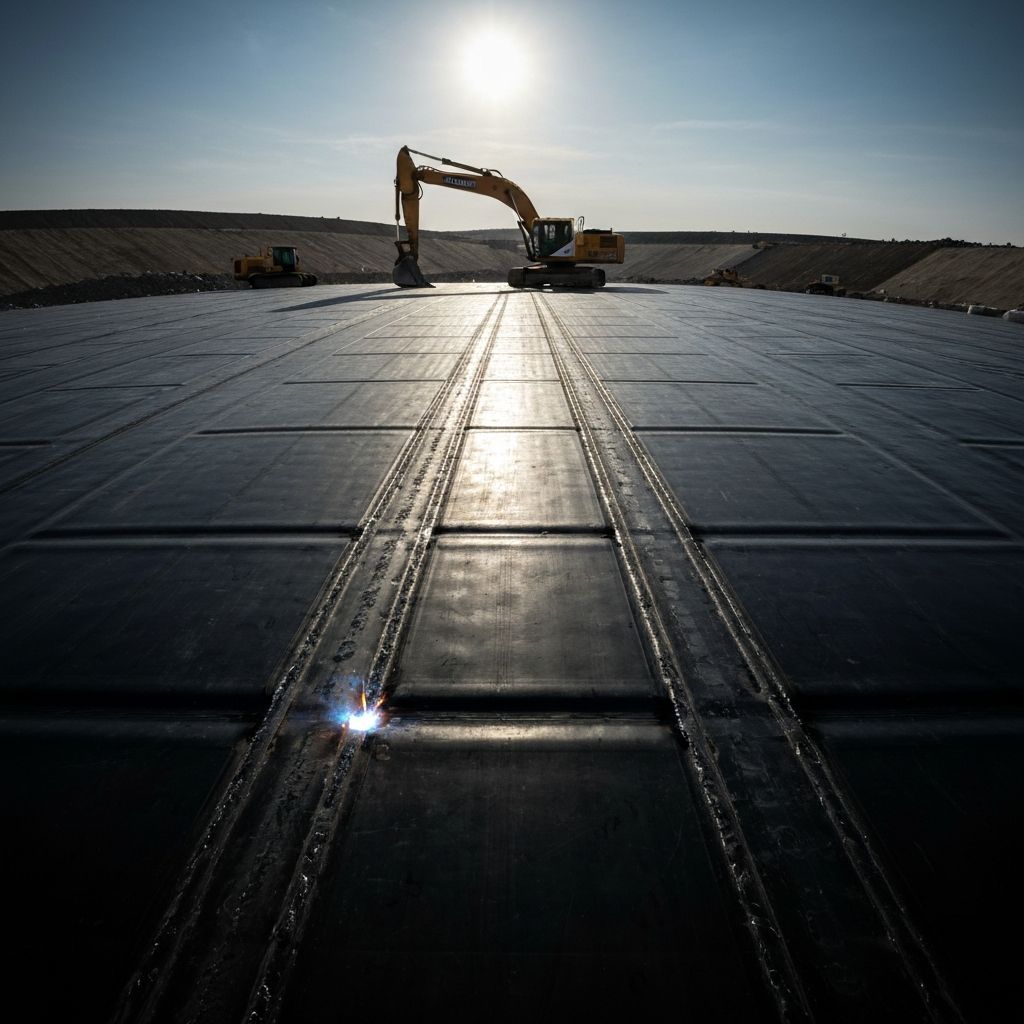
Walk onto a landfill construction site or a mining heap leach pad project, and the rolls of black HDPE geomembrane look almost identical regardless of the supplier. This visual sameness creates a dangerous assumption: that all HDPE liners perform roughly the same way.
They do not.
The difference between a geomembrane that holds for 30-plus years and one that develops stress cracks within a decade comes down to three things: the raw material formulation, the manufacturing quality control behind every technical parameter, and the welding execution on site. Get any one of these wrong, and the containment system fails—not at year 30, but sometimes at year 5 or 7.
What makes this especially tricky is that failures rarely announce themselves. A liner can pass visual inspection at installation, pass air pressure testing on the seams, and still carry the seeds of premature failure in its polymer structure. This is why HDPE geomembrane impermeability testing, geomembrane welding process qualification, and HDPE geomembrane technical parameter verification must be treated as an integrated system—not a checklist of isolated specifications.
The Permeability Baseline: What ≤1×10⁻¹³ cm/s Actually Means in the Field
Permeability—or more precisely, the permeation coefficient—is the foundational performance metric for any HDPE geomembrane impermeability application. Under GB/T 17642 and CJ/T 234 standards, a quality HDPE geomembrane tested at 0.3 MPa water pressure for 24 hours must demonstrate a permeability coefficient ≤1×10⁻¹³ cm/s. Under ASTM D5084, the same threshold applies.
To put that number in perspective: at 1×10⁻¹³ cm/s, water would take roughly 3,000 years to travel through a 1mm-thick HDPE liner—assuming pure diffusion with no defects. This is why HDPE has become the global baseline material for landfill liners, mining containment, and wastewater lagoon barriers.
Here is where things get complicated. The laboratory permeability test measures the intact sheet. It does not measure the welded seam, the corner detail, or the pipe penetration boot. These field-constructed elements are where real-world leakage occurs.
Stress Crack Resistance: The Lifetime-Limiting Property Most Specifiers Overlook
Environmental stress cracking (ESC) is not the same as chemical degradation. The polymer chains in HDPE are not being broken by oxidation—they are being pulled apart under sustained tensile load in the presence of surface-active agents. The result is a slow-developing brittle fracture that can propagate through an otherwise chemically intact liner.
The current industry-standard test for stress crack resistance is ASTM D5397—the Notched Constant Tensile Load (NCTL) test. This method measures the failure time of a notched specimen under a constant tensile load in an accelerated environmental condition, typically a surfactant solution at elevated temperature.
Under Chinese technical standards for HDPE geomembrane, the ESCR value should reach ≥1,500 hours when tested at 80°C in surfactant solution. This 1,500-hour benchmark is widely referenced across Asian procurement specifications and represents a meaningful minimum for applications where long-term containment integrity is non-negotiable.
Technical Parameter Comparison: HDPE vs. Other Geomembrane Materials
| Property | HDPE | LLDPE | PVC |
|---|
| Density (g/cm³) | ≥0.940 | 0.915–0.940 | 1.20–1.35 |
| Tensile Yield Strength (MPa) | ≥25 | ≥15 | ≥10–15 |
| Elongation at Break (%) | ≥700 | ≥800 | ≥250–300 |
| Permeability Coefficient (cm/s) | ≤1×10⁻¹³ | ≤1×10⁻¹² | ≤1×10⁻¹⁰ |
| Stress Crack Resistance—NCTL (hrs) | ≥500–1,500+ | ≥200–500 | Data not available |
| Puncture Resistance (N) | ≥400–500 | ≥300–400 | ≥200–300 |
| Service Temperature Range | −70°C to +110°C | −50°C to +80°C | −20°C to +70°C |
Hot Wedge Welding: The Process That Makes or Breaks Seam Integrity
Welding is where laboratory material properties meet field reality. The dominant field welding method for HDPE geomembrane is dual-track hot wedge (hot shoe) welding—a process where a heated metal wedge slides between two overlapping geomembrane sheets, melting both surfaces simultaneously, after which pressure rollers fuse the molten polymer into two parallel weld tracks with a central air channel.
The key parameters interact in a narrow operating window: temperature too low and the polymer does not fully fuse (cold weld); too high and the material oxidizes, becoming brittle (over-weld or burning). Speed controls dwell time under the wedge, and pressure determines the degree of intermolecular diffusion across the weld interface.
Parameter Ranges for Different Thicknesses
| Membrane Thickness | Welding Temperature | Speed | Pressure | Overlap Width |
|---|
| 0.8–1.0 mm | 300–320°C | 1.2–1.5 m/min | Moderate | ≥80 mm |
| 1.5 mm | 380–420°C | 1.5–2.0 m/min | 0.2–0.3 MPa | ≥100 mm |
| 2.0–3.0 mm | 280–300°C | 2.0–3.0 m/min | Adjust per equipment | ≥100 mm |
Weld Quality Assurance: Non-Destructive and Destructive Testing Protocols
Weld quality assurance follows a structured, three-tier approach that every geosynthetics manufacturer and installer should follow:
- Tier 1—Visual Inspection (100% of seams): Every linear meter of welded seam must be visually checked for surface defects—bubbles, charring, incomplete fusion, wrinkles, or contamination at the weld interface.
- Tier 2—Non-Destructive Testing (100% of dual-track seams): The dual-track weld geometry creates an enclosed air channel between the two parallel weld tracks. By sealing both ends and pressurizing this channel, the entire seam can be tested for leaks without cutting the liner.
- Tier 3—Destructive Testing (sampled at defined intervals): At a minimum frequency of one sample per 1,000 linear meters of seam, a destructive coupon approximately 350mm × 600mm is cut from the completed seam for laboratory testing.
What to Look for in a Geosynthetics Manufacturer
When evaluating a geosynthetics manufacturing partner for HDPE geomembrane supply, the following criteria separate serious suppliers from transactional vendors:
- GRI-GM13 compliance with full test documentation
- Third-party laboratory verification against ASTM D5397, ASTM D6693, ASTM D4833, and ASTM D3895/D5885
- On-site welding support and certification
- Traceability from resin to roll
- Transparent technical data, not marketing claims
Final Summary
HDPE geomembrane containment systems are only as strong as their weakest element. The base sheet permeability of ≤1×10⁻¹³ cm/s sets the theoretical performance ceiling, but field performance is governed by stress crack resistance—the property that determines whether a liner survives 5 years or 50—and by welding execution, where every seam represents a potential leak path that must be constructed and verified to a standard at least 80–85% of the parent material strength.
For anyone sourcing HDPE geomembrane impermeability solutions through a geosynthetics manufacturer, the lesson is straightforward: prioritize stress crack resistance evidence, insist on documented welding procedure specifications and on-site quality control, and treat the geomembrane as a system—not as a commodity sheet product.